A hotel booking engine is the part of your website where guests check availability, choose a room and pay, so the booking comes to you without an OTA commission. For a small hotel or B&B, the right one is connected to your channel manager in real time (so a direct booking closes the room on Booking.com and Expedia), handles room types, rate plans and deposits, works in the guest’s language and currency, and takes no commission per booking. Booking engines cost either a monthly subscription, a percentage per booking or a one-time fee; Hosthub’s costs $599 once for an existing WordPress site, or comes with a complete website for $799.
Every guest who books your hotel through Booking.com or Expedia costs you a commission, typically 15% or more of the booking. For a first-time guest who found you there, that is the price of being discovered. For a guest who already knows you, or found you on Google, it is money you did not need to give away. A booking engine is how you keep it. This guide explains how a hotel booking engine works, what it costs and when it pays for itself, what to look for, and how to get guests to actually book direct.
In this guide
- What a hotel booking engine is
- Booking engine, website, channel manager and PMS
- Why it matters more in 2026
- What a booking engine costs, and when it pays for itself
- What to look for: 12 must-have features
- Types of booking engine: which is best for you
- How to get more direct bookings
- How to set it up, step by step
- The Hosthub booking engine
- FAQ
What a hotel booking engine is
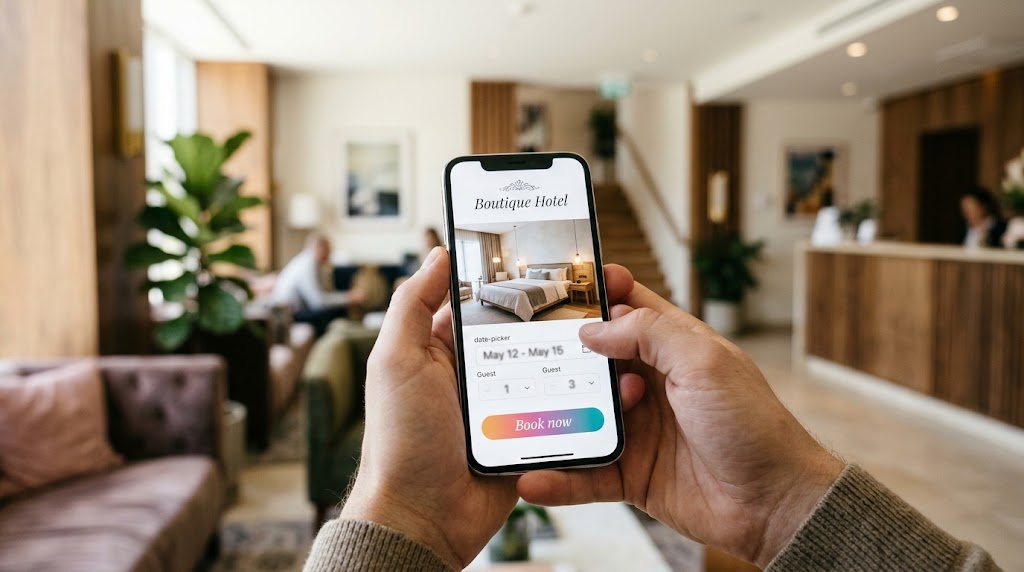
A hotel internet booking engine (often shortened to IBE) is software that turns your website into a sales channel. In practice, the guest:
- chooses dates and the number of guests;
- sees which rooms are available, with photos, prices and conditions;
- picks a room and rate, adds extras such as breakfast or a transfer, and enters their details;
- pays in full or leaves a deposit, and gets an instant confirmation.
The important part happens behind the scenes. If the booking engine is connected to your channel manager, the room closes immediately on Booking.com, Expedia, Airbnb and every other channel. If it is not, every direct booking is a double booking waiting to happen.
Booking engine, website, channel manager and PMS
Swipe the table to the right to see all columns ➜
| Website | Booking engine | Channel manager | PMS | |
|---|---|---|---|---|
| What it does | Presents the hotel: rooms, photos, location | Takes the booking and payment | Syncs availability and prices with every OTA | Runs reservations, guests, team and reports |
| Without it | No home for direct guests | Guests must email or call | Direct and OTA bookings can collide | Spreadsheets and missed details |
| Who sees it | Guests | Guests | You | You and your team |
Together, they make your own website a channel like any other, except that it pays no commission. For small hotels and B&Bs, the simplest setup is one system that does all four, so there is nothing to connect and nothing to fall out of sync.
Why it matters more in 2026
1. Direct bookings are growing. In Hosthub’s 2026 market report, covering more than 17,000 properties in Greece, direct bookings rose from 7.4% of bookings in 2024 to 10.6% in 2026, the second year of growth in a row. Behind the average, some managers take 70% to 80% of their bookings direct, while others rely entirely on the platforms. The difference is usually not the property, but whether they have a booking engine and work it.
2. Commissions keep adding up. Booking.com’s commission is generally around 15% for many properties, and Airbnb has moved hosts to a single host-only fee of about 15.5%. Every direct booking keeps that amount.
3. You own the guest relationship. From 28 September 2026, Booking.com no longer passes guests’ phone numbers to connected property management systems. With a direct booking, you have the guest’s email and phone from the start, and can invite them back next year.
4. Guests look beyond the OTAs. More travellers check Google, Google Maps and AI assistants before they book. A page where they can book you directly gives all of these somewhere to send them.
What a booking engine costs, and when it pays for itself
Booking engines are priced in three ways:
Swipe the table to the right to see all columns ➜
| Pricing model | How it works | Watch out for |
|---|---|---|
| Monthly subscription | A fixed monthly fee while you use it | You pay in the low season and the months you are closed |
| Commission per booking | A percentage of each direct booking | The better you do, the more you pay: an OTA commission by another name |
| One-time fee | Pay once and use it for good | What changes after delivery cost, and whether it needs another subscription |
In every model, the payment provider (such as Stripe or PayPal) also charges a small fee per card payment, far less than an OTA commission.
How many direct bookings to pay for it? Taking a 15% commission as the comparison, this is what each booking that comes direct instead of through an OTA saves you, and how many it takes to cover a $599 one-time booking engine:
Swipe the table to the right to see all columns ➜
| Booking value | 15% commission saved | Bookings to cover $599 |
|---|---|---|
| $300 (3 nights × $100) | $45 | about 14 |
| $500 | $75 | about 8 |
| $800 (a week) | $120 | about 5 |
| $1,200 | $180 | about 4 |
Illustrative, before payment processing fees. Hosthub’s booking engine works with a Hosthub channel manager subscription, which keeps availability and prices in sync with your other channels.
For a 10-room hotel, a handful of returning guests in the first season is usually enough.
What to look for: 12 must-have features
Types of booking engine: which is best for you
The best hotel booking engine depends less on the brand than on the rest of your setup. There are four main types:
Swipe the table to the right to see all columns ➜
| Type | Best for | Watch out for |
|---|---|---|
| Part of a hotel PMS suite | Hotels with a front desk, restaurant or night audit | Usually a monthly fee per room; more system than a small property needs |
| Built into a channel manager | Small hotels, B&Bs, guesthouses, aparthotels, vacation rentals | Check it handles room types and your payment provider |
| Website builder add-on | Properties that want a template site they edit themselves | The site and engine live inside the subscription |
| Commission-based engine | Testing direct bookings with no upfront cost | The fee grows with every direct booking |
For small hotels, guesthouses, B&Bs and aparthotels without a front-desk system, a booking engine built into your channel manager is usually the best fit: one system, one calendar, nothing to connect. Larger hotels with a restaurant, spa or night audit often already have a hotel PMS and should start there.
How to get more direct bookings
A booking engine does not bring guests on its own. These are the moves that work best for small hotels:
- Start with guests who already know you. Repeat guests are the easiest direct bookings. Tell them, at checkout and in a message after their stay, that next time they can book direct for a better rate.
- Make your website the cheapest place to book. With per-channel pricing in your channel manager, you can raise each OTA’s price to cover its commission, so your own site is automatically the best rate. Check each platform’s rate parity terms first.
- Give a reason beyond price: free breakfast, late checkout, a welcome drink or flexible cancellation for direct bookings.
- Collect contact details properly, with online check-in forms and Wi-Fi login tools, so you can invite guests back.
- Get found on Google. Keep your Google Business Profile up to date with a link to your booking page, and look at Google’s free booking links for hotels.
- Put your booking page everywhere: Instagram and Facebook bios, email signatures, business cards and the welcome folder in each room.
For more ideas, see direct bookings: why you need them and how to get them.
How to set it up, step by step
- Connect your channels to a channel manager first, so availability is in one place.
- Set up your room types and rate plans: identical rooms as one room type, with refundable and non-refundable rates if you use them.
- Connect a payment provider such as Stripe or PayPal, and set your deposit and cancellation policy.
- Add the booking engine to your website, on your own domain, with photos, descriptions and extras for each room.
- Set direct-booking pricing: your OTA markups, and any direct-only offers.
- Test a booking end to end: book, pay, receive the confirmation, and check the room has closed on every channel.
- Tell your guests, starting with past ones.
The Hosthub booking engine
Best for: small hotels, B&Bs, guesthouses, aparthotels and vacation rental managers.
Price: booking engine for your existing WordPress website, $599 one-time. No commission, no monthly booking engine fee. No website yet? A complete direct booking website built for you, from $799 one-time. Both work with a Hosthub channel manager subscription.
- Synced with every channel. Direct bookings close the room on Booking.com, Expedia, Airbnb and 200+ channels, and bookings from those channels close it on your site, in under 5 minutes, backed by a Zero Double Booking Guarantee on API-connected channels.
- Built for rooms. Sell identical rooms as one room type, and link a whole property to its individual rooms with rental relations.
- Payments your way. Stripe and PayPal, with other gateways supported; full payment or a deposit, plus extras such as breakfast or cleaning. Money reaches your account the next day.
- For international guests. Multiple languages and currencies, mobile-friendly, with search by dates.
- Offers that bring guests back. Discounts and vouchers, such as last-minute or long-stay deals.
- Your own site cheapest. Per-channel pricing raises each OTA’s rate to cover its commission.
- Everything in one place. Direct bookings land in the same calendar and inbox as every other booking, with automated messages, check-in forms and reports, in Hosthub’s PMS.
- Real people, 24/7 when you need help.
Good to know: the booking engine is built for WordPress sites. Changes after delivery are a paid service, and you choose and pay for your own hosting and domain if Hosthub builds your website. See how to create your own direct booking website, and our channel manager for B&Bs.
Frequently asked questions
What is a hotel booking engine?
Software on your hotel’s website that lets guests check availability, choose a room and pay online, so the booking comes to you directly, without an OTA commission.
How much does a hotel booking engine cost?
It depends on the model: a monthly subscription, a percentage per booking, or a one-time fee. Hosthub’s booking engine costs $599 once for an existing WordPress site, with no commission, used with a Hosthub channel manager subscription.
What is the best booking engine for a small hotel?
For most small hotels and B&Bs without a front-desk system, one built into your channel manager, so availability and prices stay in sync automatically, with no commission per booking.
What is the difference between a booking engine and a channel manager?
The booking engine takes bookings on your own website. The channel manager keeps availability and prices in sync across Booking.com, Expedia, Airbnb and your website. You need both, ideally in one system.
Do I need a booking engine if I am on Booking.com?
If you want any bookings without commission, yes. Booking.com brings new guests; a booking engine lets repeat guests and people who find you on Google book directly.
Can I add a booking engine to my existing website?
Yes. Hosthub’s booking engine adds direct bookings to an existing WordPress website, with any theme.
Market data from Hosthub’s 2026 market report. Commission levels vary by property, country and programme; check your own contracts.
About Hosthub
Hosthub is a channel manager, property management system and booking engine for small hotels, B&Bs, guesthouses, vacation rental owners and property managers. It connects your rooms to Booking.com, Expedia, Airbnb, Vrbo and 200+ other channels, keeps availability and rates in sync in under 5 minutes and backs it with a Zero Double Booking Guarantee, with direct bookings, one calendar, one inbox, automated messages, team access and reports in the same place. Try it free for 14 days.