Vacation rental revenue management means selling each night to the right guest, on the right channel, at the right price and length of stay, so that net revenue per available night is as high as possible, not just occupancy or nightly rate. For property managers, it comes down to four levers: a pricing strategy with clear base, minimum and seasonal rates; minimum-stay rules that change with the season and fill gaps; a channel mix that balances reach against commission; and a weekly routine of checking booking pace and adjusting before the dates are lost.

Most pricing advice is written for a single host with one apartment. Managers have a different problem: dozens of properties, owners who expect reports, several channels, and no time to change prices by hand every morning. This guide is for them. It includes data we have presented at Hosthub events in the last year, including booking pace from Mykonos, and the numbers behind channel mix and reviews that AirDNA shared at the Vacation Rental World Summit in Rome.
In this guide
- What revenue management is (and the KPIs that matter)
- Two numbers every manager should know
- Pricing strategy: base, floor, seasons and lead time
- A real example: booking pace in Mykonos
- Minimum stay strategy
- Channel mix: reach versus commission
- A weekly revenue management routine
- Reporting revenue to owners
- Where revenue management is heading
- FAQ
What revenue management is (and the KPIs that matter)
Pricing is setting a rate. Revenue management is the system around it: forecasting demand, deciding which bookings to accept and on which terms, and measuring the result. A full calendar at low prices is not success, and neither is a high nightly rate on a half-empty calendar. The metric that combines both is revenue per available night, and for managers, the version after commissions.
Swipe the table to the right to see all columns ➜
| KPI | What it measures | How to calculate | Example |
|---|---|---|---|
| Occupancy | Share of available nights that were sold | Nights sold ÷ nights available | 22 of 30 nights = 73% |
| ADR (average daily rate) | Average price of a sold night | Room revenue ÷ nights sold | €3,300 ÷ 22 = €150 |
| RevPAR | Revenue per available night, sold or not | Room revenue ÷ nights available (or ADR × occupancy) | €3,300 ÷ 30 = €110 |
| Net RevPAR | RevPAR after commissions and payment fees | (Revenue − commissions − fees) ÷ nights available | (€3,300 − €450) ÷ 30 = €95 |
| Booking pace | How fast future dates are filling, compared with last year | Occupancy or revenue on the books today vs the same date last year | 60 days out: 45% vs 38% last year |
| Booking window (lead time) | How far ahead guests book | Average days between booking and arrival | 71 days |
| Average length of stay | Nights per booking | Nights sold ÷ number of bookings | 22 ÷ 5 = 4.4 nights |
| Channel share | Where bookings and revenue come from | Revenue per channel ÷ total revenue | Airbnb 55%, Booking.com 35%, direct 10% |
Track net, not gross. A €200 night on a channel that keeps 18% earns you less than a €180 night booked direct. Calculate RevPAR after commissions, payment fees and cleaning costs, per property and per channel, and compare like with like: the same property, the same month, last year.
Two numbers every manager should know
Channel mix: most listings rely on a single platform
At the Vacation Rental World Summit in Rome (October 2025), AirDNA’s chief economist Jamie Lane presented how European short-term rentals are distributed across Airbnb, Booking.com and Vrbo in 2025:
Share of European short-term rental listings by platform, 2025. Source: AirDNA, presented at VRWS 2025, Rome.
Seven in ten listings, 49% + 15% + 6%, sell on one platform only. Every one of those depends on a single algorithm, a single fee structure and a single set of rules. Spreading across two or three channels, with a channel manager to keep calendars in sync, is the simplest way to reduce that risk and reach guests who never open Airbnb.
Reviews: every tenth of a star shows up in revenue
In the same session, AirDNA showed annual RevPAR in Europe by Airbnb review score, controlling for location, size, property type and amenities:
Annual RevPAR by Airbnb review score in Europe, controlling for location, size, property type and amenities. Source: AirDNA, presented at VRWS 2025, Rome.
A 5.0 listing earned 14% more per available night than a comparable 4.7–4.8 listing, and 30% more than one under 4.5. Revenue management is not only a pricing job: cleaning, check-in and guest communication feed straight into the rate you can charge.
Pricing strategy: base, floor, seasons and lead time
A pricing strategy a team can follow has five parts, set per property and reviewed every season:
- A base rate for a normal night in each season, from your own history and comparable listings nearby.
- A floor (minimum price) below which you would rather leave the night empty, covering cleaning, laundry, utilities, commission and the owner’s minimum.
- A ceiling for peak dates and events, so a pricing tool cannot overreach and cause cancellations or bad reviews.
- Seasons, weekdays and events: separate rates for high, shoulder and low season, weekends, holidays, festivals and conferences.
- Lead-time rules: how prices move as the date approaches.
The last part is where most managers leave money on the table. A simple lead-time ladder:
Swipe the table to the right to see all columns ➜
| When the date is… | Typical move | Why |
|---|---|---|
| 6+ months away | Hold or slightly above base rate | Early bookers plan peak trips and are less price-sensitive; do not sell peak cheaply |
| 2–6 months away | Follow pace: raise if ahead of last year, hold if on track | This is when most leisure demand books |
| 3–8 weeks away | Adjust to the market; relax minimum stays | Unsold nights now face real competition |
| Under 2 weeks | Discount gradually, never below your floor | An empty night earns nothing, but too-low prices train guests to wait |
| Gap nights | Lower minimum stay and small discount | Orphan nights rarely sell otherwise |
Use a pricing tool, but give it rules. Dynamic pricing tools such as PriceLabs and Beyond read market demand every day and adjust prices within the limits you set. Hosthub connects to them and sends the result to every channel. The tool handles the daily changes; your job is the base, floor, ceiling and the exceptions it cannot know about, such as a renovation next door or a wedding booked in town. See all smart pricing partners.
A real example: what booking pace showed in Mykonos
Booking pace is the most useful signal for adjusting these rules, and the easiest to misread. Here is how it looked in one seasonal market. At our Hosthub workshop in Mykonos on 29 April 2026, we showed the island’s booking pace from properties managed with Hosthub: what was on the books for the 2026 season, compared with what was on the books at the same point in 2025. It is a single market at a single moment, but the pattern is common in any destination with a strong peak season.
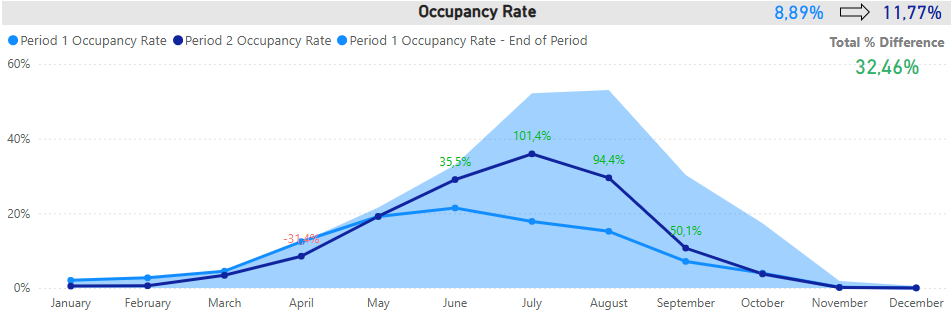
Occupancy on the books, Mykonos. Dark line: 2026 season. Light line: 2025 season at the same date. Shaded area: where 2025 finished. Source: Hosthub data, presented at the Hosthub Mykonos workshop, April 2026.
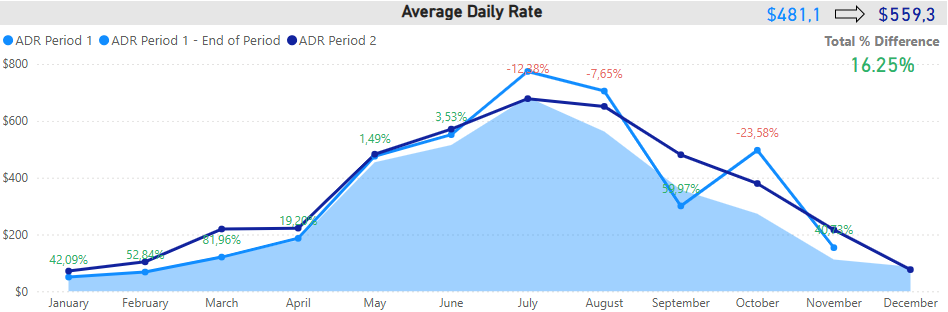
Average daily rate on the books, Mykonos, same comparison. Source: Hosthub data, presented at the Hosthub Mykonos workshop, April 2026.
Three things stood out:
- Guests booked earlier. Occupancy on the books was 11.8%, against 8.9% at the same point a year before, a 32% increase. For July it had roughly doubled (+101%), and for August it was up 94%.
- The average rate was up, but not where demand was strongest. The average daily rate on the books rose 16% overall, from $481 to $559. Yet July was 12% and August 8% below the rate at the same point in 2025.
- The shoulder months gained the most in rate. February (+53%) and March (+82%) were well ahead of the year before.
What it means for managers: when bookings for peak weeks arrive much faster than last year, the market is telling you the price is too low. Pace this far ahead was a signal to raise July and August rates and minimum prices, not to celebrate the full calendar. Every peak night sold early at last year’s price is a night you cannot sell later at this year’s.
Minimum stay strategy
Minimum-stay rules are a revenue tool, not a fixed setting. Every turnover costs cleaning, laundry and a gap night you might not sell. Too long a minimum, and you lose the guests who only want three nights. Set them by season and by how far away the date is:
Swipe the table to the right to see all columns ➜
| Period | Booked months ahead | Booked last-minute |
|---|---|---|
| Peak season (e.g. July–August) | 5–7 nights, or weekly changeovers | 3–4 nights, or to fill the exact gap |
| Shoulder season | 3–4 nights | 2 nights |
| Low season | 2 nights | 1 night |
| Holidays and events | Longer minimum over the event dates | Fill the gap |
| Weekends in city properties | 2 nights over Friday–Saturday | 1 night |
- Fill orphan nights. A one- or two-night gap between bookings rarely sells under a five-night minimum. Lower the minimum for that gap only, and consider a small discount.
- Relax the minimum as the date approaches. A seven-night minimum makes sense for August booked in February, not for a free week booked ten days out.
- Price length, not just nights. Weekly and monthly discounts attract longer stays in low season, when one turnover saved is worth more than a few euros a night.
- Remember the cleaning fee. On short stays it makes the total look expensive; some managers fold part of it into the nightly rate for one- and two-night bookings.
In Hosthub, minimum and maximum stays are part of each property’s defaults and can be changed for any season or date range with date exceptions, which are sent to your channels automatically. Preparation time blocks nights between stays when a property needs them.
Channel mix: reach versus commission
Each channel brings different guests at a different cost. Airbnb is strong with leisure travellers and longer stays, Booking.com with international, last-minute and shorter stays, Vrbo with families and groups, Expedia with travellers who book hotels, and your own website with returning guests at no commission. A good mix is not “as many as possible”: it is enough channels to fill the calendar in every season, priced so that each one pays you what you need.
Same payout on every channel, or the same price?
You have two options:
- Same payout (dynamic rates): raise the price on each channel by its commission, so you earn the same per night everywhere. Hosthub’s rate management shows the idea with a $100 night: it sends $103 to Airbnb, $115 to Booking.com and $118 to Expedia, based on each channel’s fee.
- Rate parity: show the same price everywhere and accept a different payout per channel. Hotels often choose this, and some channels’ contracts ask for it.
A common mistake: to recover a 15% commission, a 15% markup is not enough. On a €100 price with a 15% markup, the guest pays €115 and the channel keeps €17.25, leaving €97.75. You need a markup of 17.6% to keep €100. The calculator does the maths for any commission:
In Hosthub, you set a markup or discount for each channel, from −95% to +95%, and every property is recalculated automatically. Rates and rate plans are sent to Airbnb, Booking.com, Vrbo, Expedia and your direct booking website, while availability stays in sync with 200+ channels in under 5 minutes. You can run several rate plans per channel, for example a non-refundable rate on Booking.com, at no extra cost.
Don’t forget direct bookings
Repeat guests and guests who find you on Google can book on your own website with no commission. Even a modest share of direct bookings lifts net RevPAR across the portfolio. A booking engine on your website, synced with your other channels, makes that possible without double bookings.
A weekly revenue management routine
Revenue management works when it is a habit. A routine a manager or revenue lead can run in an hour a week:
- Check pace. Compare occupancy and rate on the books for the next 30, 60 and 90 days against the same point last year. Ahead of last year means raise rates; behind means look at price, minimum stay and channel visibility.
- Find gaps. Look for orphan nights and unsold weekends in the next three weeks and adjust minimum stays or prices.
- Review exceptions. Add new events, holidays and local happenings to your calendar before your pricing tool sees the demand.
- Look at channel performance. Which channel brought bookings this month, at what net rate and lead time? Adjust markups if one channel undersells.
- Read the reviews. A falling review score is a revenue warning. Fix the cause before it shows up in your rate.
- Update owners. Send a short note on pace and decisions, so they hear it from you before they notice it themselves.
Hosthub’s reports and charts show booked nights, average length of stay, occupancy and revenue, filtered by channel, property and date range, so the routine starts from one screen.
Reporting revenue to owners
Owners rarely care about ADR or RevPAR by name. They care about three things: how much they earned, how that compares with last year and the market, and what you are doing about it. A good monthly owner report shows gross and net revenue, occupancy and average rate, bookings by channel, the expenses deducted, and two or three lines on your pricing decisions. Hosthub’s automated owner reports and owner portal send this without a spreadsheet.
Where revenue management is heading
At the Short Stay Conference in Athens in February 2026, Hosthub’s co-founder and CEO Alexander Caravitis described the next step: a “revenue optimization agent”. Instead of suggesting prices for a person to approve, it sets a goal, such as maximising RevPAR while protecting an occupancy floor. It then monitors events, competitor prices and booking pace, adjusts rates across Airbnb, Booking.com and direct, tests strategies and reports to owners on its own. As he put it: “It doesn’t ‘suggest prices.’ It owns the revenue KPI.”
Some managers are already close to this, with a pricing tool, a channel manager and automated reports working together. The rules in this guide remain the part a person sets: the floor, the ceiling, the minimum stays and the channel strategy that the automation works within.
Frequently asked questions
What is vacation rental revenue management?
It is the practice of setting prices, minimum stays and channel distribution to maximise net revenue per available night, using demand forecasts, booking pace and performance data, rather than setting one price per season.
What is the difference between ADR and RevPAR?
ADR is the average price of the nights you sold. RevPAR is revenue divided by all available nights, sold or not, so it combines price and occupancy. Raising ADR while occupancy drops can lower RevPAR.
What is booking pace?
How fast reservations come in for future dates, compared with the same point last year. If pace is ahead, demand is stronger or your price is too low; if it is behind, the price, minimum stay or visibility may need attention.
What is a good minimum stay for a vacation rental?
It depends on the season and how far ahead the date is: often five to seven nights in peak season booked months ahead, two to three in shoulder season, and one or two in low season or for last-minute gaps.
Should I charge more on Booking.com than on Airbnb?
If you want the same payout everywhere, yes: raise each channel’s price to cover its commission. To keep €100 after a 15% commission, the price must be about €117.65, not €115. Check each channel’s rules on rate parity first.
Do I need a revenue management tool?
For more than a few properties, yes. A dynamic pricing tool handles daily demand changes, and a channel manager sends the result to every channel and keeps calendars in sync. Your strategy sets the rules both follow.
Mykonos booking pace: Hosthub data from properties managed with Hosthub, presented on 29 April 2026. Channel mix and review score data: AirDNA, presented at VRWS 2025, Rome, 30 October 2025. Product details checked in October 2026.
About Hosthub
Hosthub is a channel manager and property management system for short-term rental hosts, B&Bs, small hotels and property managers. It connects your properties to Airbnb, Booking.com, Vrbo, Expedia and 200+ other channels, keeps availability in sync in under 5 minutes and backs it with a Zero Double Booking Guarantee, with per-channel rates, multiple rate plans, one calendar, one inbox, automated messages, reports and owner reporting in the same place. Try it free for 14 days.