An Airbnb co-host agreement is a written contract between a property owner and the co-host who manages the listing for them. It sets out what the co-host does, what access they get on Airbnb, how much they are paid and on what, who pays for cleaning and repairs, and how either side can end the arrangement. Airbnb lets you add a co-host and split payouts, but it does not give you a contract. Download our free template below, fill in the highlighted fields and have it checked locally before you sign.

Most co-hosting arrangements start with a handshake between friends, neighbours or a local host who “helps out”. They usually go wrong over the same few things: what the percentage is calculated on, who keeps the cleaning fee, what happens to the fee when a guest cancels, and who manages bookings that were made before the co-host left. A two-page agreement settles all of that before it becomes a problem.
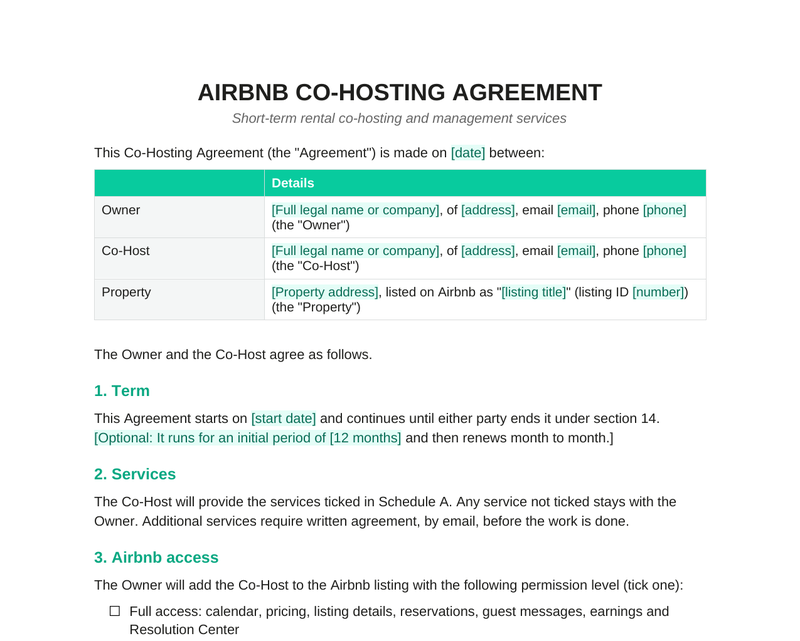
Free Airbnb co-host agreement template (Word)
17 clauses plus two schedules: a services and fees checklist, and a page for spending limits, minimum rates and emergency contacts. Every field you need to fill in is highlighted, and every option is written out so you just delete the ones that do not apply.
In this guide
- Do you need a co-host agreement?
- How co-hosting works on Airbnb
- What to include: the 17 clauses
- How much does a co-host charge?
- The commission clause, worked out
- The 5 clauses that cause most disputes
- How to set it up, step by step
- Co-hosting on more than one channel
- FAQ
Do you need a co-host agreement?
Yes, even with a friend or family member. Airbnb’s co-host tools control what the co-host can do on the listing and, where available, how Airbnb splits the payout. They do not cover anything else:
- which services the co-host provides, and which stay with you;
- who pays for cleaning, supplies and repairs, and up to what amount without asking;
- bookings from Booking.com, Vrbo or your own website;
- personal stays, minimum prices and house rules;
- insurance, damage and liability;
- how and when the arrangement ends.
Airbnb is also clear that the listing owner is responsible for every co-host on the listing. If something goes wrong, the agreement is what shows who agreed to do what.
How co-hosting works on Airbnb
The owner invites the co-host from the listing settings and chooses one of three permission levels. You can add up to 10 co-hosts to a listing, and each one has to verify their identity before accepting.
Swipe the table to the right to see all columns ➜
| What the co-host can do | Full access | Calendar and messaging | Calendar only |
|---|---|---|---|
| Message guests | ✓ | ✓ | ✗ |
| View the calendar | ✓ | ✓ | ✓ |
| Edit calendar, prices and listing details | ✓ | ✗ | ✗ |
| Accept, decline or cancel reservations | ✓ | ✗ | ✗ |
| Damage claims and Resolution Center | ✓ | ✗ | ✗ |
| View earnings and payouts | ✓ | ✗ | ✗ |
| Write guest reviews | ✓ | ✗ | ✗ |
| Invite or remove other co-hosts | ✓ not full-access ones |
✗ | ✗ |
| Receive co-host payouts | ✓ | ✓ | ✓ |
Co-host payouts. Where Airbnb offers it, the owner can share part of each payout with a co-host, as a percentage or a fixed amount per reservation. Both sides have to approve the split, and it only applies to reservations that check in after it is approved. If a guest is later refunded, Airbnb can recover what it overpaid the co-host from future payouts. Only the listing owner can set up or change a co-host’s payout.
The payout split moves the money. The agreement says what the money is for.
What to include: the 17 clauses
Our template covers each of these. Use it as a checklist even if you write your own.
- Parties and property: full names, contact details, the property address and the Airbnb listing ID.
- Term: start date, and whether it runs month to month or for a fixed period.
- Services: a ticked list of what the co-host does. Anything not ticked stays with the owner.
- Airbnb access level: full access, calendar and messaging, or calendar only, and whether the co-host is shown to guests as the primary host.
- Other channels and direct bookings: whether the agreement, and the fee, also cover Booking.com, Vrbo and your own website.
- Owner responsibilities: repairs, safety equipment, insurance, licences, utilities and notice of personal stays.
- Co-host fee: a percentage, a fixed fee or both, and exactly what the percentage is calculated on.
- Payment of the fee: through Airbnb’s payout split, by monthly invoice, or both, and what happens after a refund.
- Cleaning and the cleaning fee: who cleans, who keeps the guest cleaning fee and who pays for linen and supplies.
- Expenses and approval limits: how much the co-host can spend without asking, and how they are reimbursed.
- Pricing and house rules: a minimum nightly rate, and what the co-host cannot change without consent, such as the cancellation policy or pet rules.
- Damage and claims: how damage is documented and claimed, and who receives what is recovered.
- Reporting: a monthly owner statement, by a set date, with every booking, fee and expense.
- Insurance and liability: who carries what insurance, and who is responsible for what.
- Ending the agreement: notice period, what happens to future bookings, and handing back keys, codes and access.
- Confidentiality and guest data: guest data used only for managing stays, and no poaching of guests.
- Independent contractor and general terms: the co-host is not an employee, which law applies, and how disputes are handled.
How much does a co-host charge?
Most co-hosts charge a percentage of booking revenue. Airbnb’s Co-Host Network, its marketplace of vetted co-hosts, typically sees fees of 10% to 30%, depending on how much the co-host does. Co-hosting companies report ranges like these:
Swipe the table to the right to see all columns ➜
| Level of service | What it usually includes | Typical fee |
|---|---|---|
| Messaging and calendar | Guest messages, calendar and reviews | 10–15% |
| Part management | Plus cleaning coordination, pricing and maintenance call-outs | 15–20% |
| Full service | Plus listing setup, photography and revenue management | 20–25% or more |
| Flat monthly fee | A fixed amount per property, common for lower-revenue homes or messaging only | Fixed per month |
| Hybrid | A small retainer plus a fee per turnover, or a lower percentage plus extras | Mixed |
Cleaning is normally outside the commission: the guest cleaning fee goes to the cleaner. If the co-host cleans personally, they either keep the cleaning fee or charge a higher percentage. Whatever you agree, write it down, because it is the most common source of disagreements.
The commission clause, worked out
“20%” means very different amounts depending on what it is 20% of. Take one booking: $1,000 for the nights plus a $120 cleaning fee, on a listing with Airbnb’s 15.5% host-only fee.
Swipe the table to the right to see all columns ➜
| 20% calculated on… | Basis | Co-host earns | Owner keeps* |
|---|---|---|---|
| Gross nightly revenue | $1,000.00 | $200.00 | $626.40 |
| Payout for the nights, excluding cleaning | $845.00 | $169.00 | $657.40 |
| Total payout, including cleaning | $946.40 | $189.28 | $637.12 |
*Airbnb payout of $946.40 ($1,120 minus the 15.5% host-only fee of $173.60), minus the co-host fee and $120 paid to the cleaner.
The difference is $31 on a single booking, and over 60 bookings a year it adds up to more than $1,800. Neither option is wrong, but both sides must mean the same one. Our template defines gross booking revenue and asks you to choose the basis in writing.
The 5 clauses that cause most disputes
- What the percentage is calculated on. Gross or payout, with or without the cleaning fee, extra-guest fees and pet fees. See the example above.
- Cancellations and refunds. Agree that the fee is earned on money actually received, so it goes down when a guest is refunded. Airbnb already recovers overpaid co-host payouts after a refund; your agreement should treat other channels the same way.
- Spending without asking. A spending limit per item, such as $150, lets the co-host fix a broken kettle at 10 p.m. without a phone call, and stops a $900 surprise.
- Owner stays and blocked dates. Require notice for personal stays, and agree whether the co-host earns anything on dates the owner blocks during high season.
- Bookings after the agreement ends. Summer bookings are often made in winter. Decide now whether the co-host manages and earns on stays booked before the end date, or hands them over.
How to set it up, step by step
- Agree the scope. Go through Schedule A of the template together and tick each service.
- Agree the fee and its basis, the cleaning fee, the spending limit and the minimum nightly rate.
- Fill in and sign the agreement. Have a local lawyer review it, especially where short-term rentals need a licence or registration.
- Invite the co-host on Airbnb with the access level you agreed. Give the minimum that lets them do the job.
- Set up the payout split on Airbnb, if you are using it, to match clause 7.
- Give access on your other channels and tools, such as your channel manager, smart locks and cleaning app, with the same care.
- Agree the first monthly statement date and check the first one together.
Co-hosting on more than one channel
Airbnb’s co-host tools only cover Airbnb. Many co-hosts also manage the owner’s listings on Booking.com, Vrbo and a direct booking site, and that is where arrangements get messy: separate logins, separate payouts and a monthly spreadsheet to work out the fee.
This is where a channel manager and PMS like Hosthub helps, for owners and co-hosts alike:
- One calendar for every channel. Airbnb, Booking.com, Vrbo, Expedia and 200+ channels in sync in under 5 minutes, backed by a Zero Double Booking Guarantee on API-connected channels.
- The right access for each person. With team management, the co-host, the cleaner and the owner each see only what they need, with custom roles on the Pro plan, and no sharing of Airbnb passwords.
- Fees and statements done for you. Hosthub records expenses, calculates the management fee on each booking from every channel and produces owner reports, which covers clause 12 of the agreement. Owners can check bookings and earnings in their own owner portal.
- Guest messages answered day and night. One inbox for every channel, with an AI Co-host that learns each property’s details and your past answers and replies to guests 24/7, or suggests a reply for the co-host to approve.
If you are building a co-hosting business, the same setup scales from one owner to fifty. Our owner statement template pairs well with this agreement if you are not using software yet.
Frequently asked questions
Does Airbnb provide a co-host agreement?
No. Airbnb provides co-host tools, permission levels and, where available, payout splits, plus its own terms for co-hosting. The agreement between the owner and the co-host is up to you.
Is an Airbnb co-host agreement legally binding?
A signed agreement is generally a binding contract, as long as it meets the requirements of your local law. Rules vary by country and state, so have a local lawyer review the template before you sign.
What percentage does an Airbnb co-host get?
Typically 10% to 30% of booking revenue, depending on the services. Messaging and calendar only sits at the low end; full management, including pricing, cleaning coordination and maintenance, at the high end.
Can a co-host be paid through Airbnb?
Where Airbnb offers co-host payouts, the owner can share a percentage or a fixed amount of each payout with the co-host. Both sides must approve it, and it applies to reservations that check in after approval.
Who pays the cleaning fee?
The guest pays it, and it usually goes to whoever cleans. Agree in writing whether it is excluded from the co-host’s percentage; in most agreements it is.
Does a co-host need insurance?
The owner should hold short-term rental insurance for the property. Many professional co-hosts also carry general liability insurance. Airbnb’s host protection programs have conditions and limits, so check what applies in your country.
Who is responsible to Airbnb for the listing?
The listing owner. Airbnb holds the owner responsible for every co-host on the listing, including co-hosts added by a full-access co-host.
Can I use this template for Booking.com and Vrbo?
Yes. Clause 4 lets you extend the agreement and the fee to other channels and direct bookings.
This article and template are general information, not legal or tax advice. Airbnb features and terms checked in October 2026 on Airbnb’s Help Center.
About Hosthub
Hosthub is a channel manager and property management system for short-term rental hosts, co-hosts, B&Bs, small hotels and property managers. It connects your properties to Airbnb, Booking.com, Vrbo, Expedia and 200+ other channels, keeps availability and rates in sync in under 5 minutes and backs it with a Zero Double Booking Guarantee, with one calendar, one inbox, an AI Co-host, team access, reports and owner reporting in the same place. Try it free for 14 days.